🍂 Fall Exclusive: Exclusive Member Pricing | 🚚 Free Shipping Over $199 | 📦 Only $20 Flat-Rate Shipping Under $199





Medoptimal Blog
Chlorhexidine 2% vs 4%: Differences, Uses and How to Choose
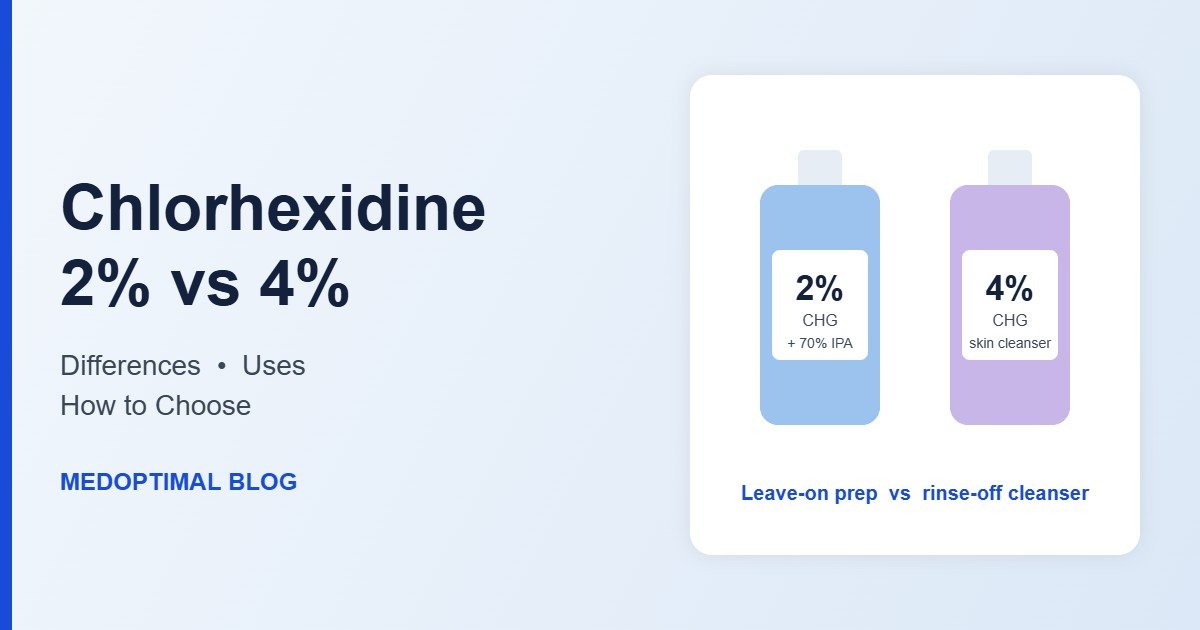
Quick answer: Chlorhexidine gluconate (CHG) 2% and 4% are both skin antiseptics, but they usually come in different formulations made for different jobs. 4% CHG is most often a low-sudsing antiseptic skin cleanser or scrub that is used with water and rinsed off. 2% CHG is most often combined with 70% isopropyl alcohol as a leave-on skin prep before procedures, or supplied as a water-based (aqueous) solution. Choose by formulation and the product label, not by the percentage alone.
What is chlorhexidine gluconate?
Chlorhexidine gluconate is an antiseptic widely used in healthcare to reduce the number of microorganisms on the skin, for example before injections, catheter insertion and surgery, and for antiseptic hand and skin washing. In Canada it is sold under brand names such as Stanhexidine, Baxedin, Dexidin and SoluPrep.
The percentage on the label tells you the CHG concentration. What the product is designed to do depends just as much on what else is in it, for example whether it contains a detergent for washing or 70% alcohol for a fast-drying skin prep.
Chlorhexidine 2% vs 4% at a glance
| Formulation | CHG strength | How it is typically used | Examples at Medoptimal |
|---|---|---|---|
| Antiseptic skin cleanser (low-sudsing, rinse-off) | 4% | Antiseptic hand and skin washing, and surgical hand scrub where the label allows | Stanhexidine 4% Skin Cleanser |
| Alcohol-based skin prep (leave-on) | 2% CHG + 70% isopropyl alcohol | Skin preparation before surgery, injections and vascular access | Baxedin, SoluPrep Prefilled Applicator |
| Aqueous (water-based) solution | 2% | Skin cleansing where an alcohol-based prep is not wanted, as directed on the label | Stanhexidine Aqueous 2%, Dexidin 2 Aqueous |
| Low-strength alcohol swab | 0.5% CHG + 70% isopropyl alcohol | Small-area skin prep | SoluPrep QD Small Swab |
Always follow the directions on the specific product label and your facility’s protocol.
When is 4% chlorhexidine used?
4% CHG is the classic strength for antiseptic skin cleansers and scrubs. These are usually low-sudsing liquids that are lathered with water and then rinsed off, for example for antiseptic hand washing or a surgical hand scrub. Stanhexidine 4% Skin Cleanser is an example: a low-sudsing antibacterial skin cleanser containing 4% chlorhexidine gluconate with 4% isopropyl alcohol, made for professional healthcare use.
When is 2% chlorhexidine used?
2% CHG is most often found in two formats:
- 2% CHG with 70% isopropyl alcohol: a leave-on skin prep that combines chlorhexidine with alcohol. In a multicentre randomized trial published in the New England Journal of Medicine (2010), surgical-site infection after clean-contaminated surgery was lower with chlorhexidine-alcohol skin cleansing than with povidone-iodine (9.5% vs 16.1%). For central venous and peripheral arterial catheters, the U.S. CDC recommends preparing clean skin with a chlorhexidine preparation of more than 0.5% with alcohol.
- 2% aqueous CHG: a water-based solution, such as Stanhexidine Aqueous 2% (which contains 4% isopropyl alcohol) or Dexidin 2, used for skin cleansing according to its label.
Is 4% chlorhexidine stronger or better than 2%?
A 4% product has a higher concentration of chlorhexidine, but that does not make it the better choice for every task. A 4% rinse-off cleanser and a 2% chlorhexidine-alcohol prep are designed for different jobs, so they are not interchangeable. Pick the product whose label matches the procedure, and follow your facility’s skin antisepsis protocol.
Safety tips for using chlorhexidine
- Keep it out of the eyes, ears and mouth. Product labels warn that contact with the eyes can cause serious injury and that use in the middle ear (for example through a perforated eardrum) can cause deafness. Do not use it on mucous membranes unless the label says so.
- Alcohol-based preps are flammable. Let the skin dry completely and keep away from ignition sources, as directed on the label.
- Ask about allergies. In 2017 the U.S. FDA warned that chlorhexidine skin antiseptics can, rarely, cause serious allergic reactions, including anaphylaxis. Ask patients about previous reactions before use and stop use if a reaction occurs.
- Check the label for age limits. Some chlorhexidine products carry warnings for premature infants and young babies.
Buying chlorhexidine for your clinic
Medoptimal supplies chlorhexidine skin cleansers, alcohol-based skin preps and aqueous solutions to clinics across Ontario, including Stanhexidine 4%, Stanhexidine 2% Skin Cleanser, Stanhexidine Aqueous 2%, Baxedin and SoluPrep. For more on Stanhexidine specifically, read our Stanhexidine guide. Registered trade customers can log in to see pricing and order online.
Frequently asked questions
What is the difference between 2% and 4% chlorhexidine?
The main difference is the formulation. 4% chlorhexidine is usually a rinse-off antiseptic skin cleanser or scrub, while 2% chlorhexidine is usually a leave-on skin prep combined with 70% alcohol, or a water-based solution.
Can I use 4% chlorhexidine instead of 2% chlorhexidine with alcohol?
Not as a direct swap. The products are designed and labelled for different uses. Use the product whose label matches the task and follow your facility’s protocol.
Which chlorhexidine is used before surgery?
Pre-operative skin preparation commonly uses 2% chlorhexidine in 70% isopropyl alcohol. A 2010 randomized trial found lower surgical-site infection rates with chlorhexidine-alcohol than with povidone-iodine in clean-contaminated surgery.
Is chlorhexidine safe near the eyes and ears?
No. Keep chlorhexidine out of the eyes, ears and mouth. Eye contact can cause serious injury, and use in the middle ear can cause deafness.
Can people be allergic to chlorhexidine?
Yes, although serious reactions are rare. The U.S. FDA warned in 2017 that chlorhexidine skin antiseptics can cause serious allergic reactions, including anaphylaxis.
What does aqueous chlorhexidine mean?
Aqueous means water-based. Aqueous chlorhexidine solutions do not contain the 70% alcohol found in alcohol-based skin preps, although some contain a small amount of alcohol, as Stanhexidine Aqueous 2% contains 4% isopropyl alcohol.
Sources
- Darouiche RO, et al. Chlorhexidine-alcohol versus povidone-iodine for surgical-site antisepsis. New England Journal of Medicine, 2010. nejm.org
- U.S. CDC. Guidelines for the Prevention of Intravascular Catheter-Related Infections: summary of recommendations. cdc.gov
- U.S. FDA Drug Safety Communication on rare but serious allergic reactions to chlorhexidine gluconate (2017). fda.gov
This guide is for general information for healthcare professionals and does not replace product labels, facility protocols or medical advice.