🍂 Fall Exclusive: Exclusive Member Pricing | 🚚 Free Shipping Over $199 | 📦 Only $20 Flat-Rate Shipping Under $199





Medoptimal Blog
Snellen Eye Chart: How to Use an Eye Test Chart and Read the Results
Quick answer: A Snellen eye chart is the standard wall chart used to check distance vision. The person stands 20 feet (6 metres) away, covers one eye, and reads the letters from the top down. The smallest line they can read correctly gives their visual acuity score, such as 20/20 (6/6 in metric). This guide walks through how to set up the chart, run the test step by step, read the results, and when to refer someone for a full eye exam.
What is a Snellen eye chart?
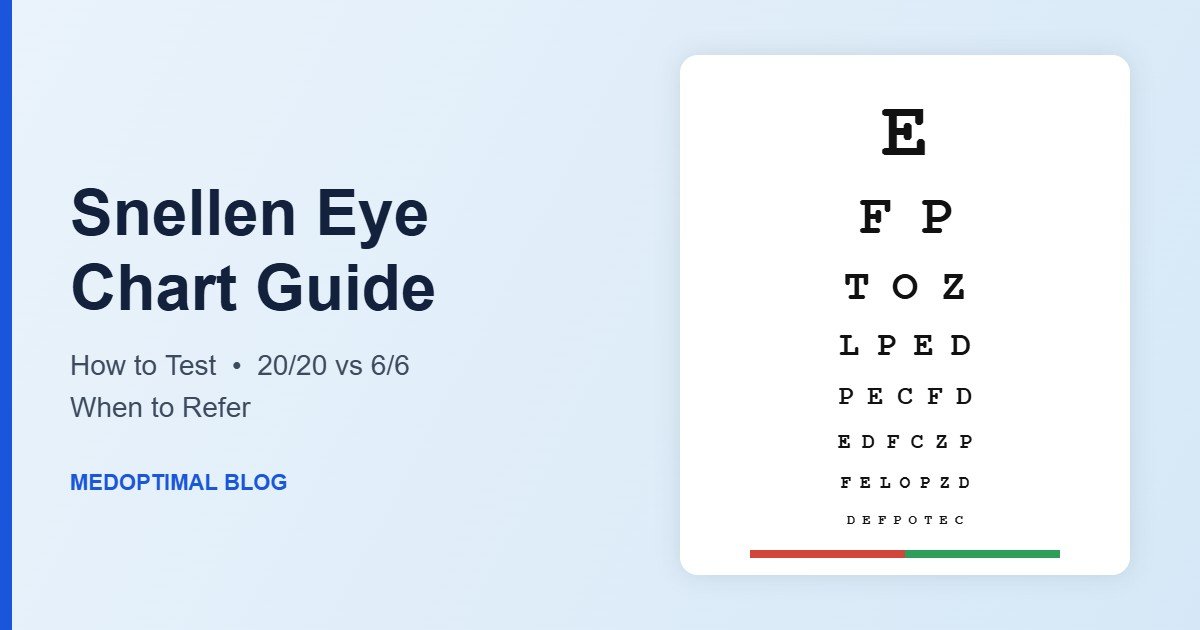
The Snellen chart was developed by Dutch eye doctor Herman Snellen in 1862 and is still the most widely used eye test chart in clinics, schools, and workplaces. It has rows of letters that get smaller from top to bottom. Each row matches a visual acuity level, so the chart measures how clearly a person can see detail at a distance.
It is a screening tool, not a full eye exam. A Snellen test tells you how sharp someone’s distance vision is. It does not check eye health, eye pressure, peripheral (side) vision, or near vision. Anyone with a poor result or eye symptoms should see an optometrist or ophthalmologist.
Where Snellen charts are used
- Family practice and walk-in clinics, as part of routine physicals and pre-employment medicals.
- Occupational health, for workplace vision screening.
- School and public health nurses, for quick vision checks.
- Physiotherapy, chiropractic, and rehab clinics, as part of a general assessment.
- Driver medicals, since driver’s licence vision standards are expressed as a Snellen score.
What you need
- A Snellen eye chart
- A clear space of 20 feet (6 metres) between the chart and the person being tested. Check the test distance printed on your chart, since some charts are designed for shorter rooms.
- Good, even lighting on the chart, with no glare or shadows
- An occluder (eye cover), or a clean card the person can hold over one eye
- A pointer, and a form to record the results
How to set up the chart
- Mount it at eye level. Hang the chart so the middle rows are roughly at the eye height of a seated or standing adult.
- Light it well. The chart should be evenly lit. Avoid placing it next to a window, where glare or backlighting can make letters harder to read.
- Measure and mark the distance. Measure 20 feet (6 metres) from the chart and mark the spot on the floor with tape so every test is done from the same place.
How to do a Snellen eye test, step by step
- Position the person at the marked line, standing or sitting upright. If they wear distance glasses or contact lenses, test with them on and note “with correction” on the form.
- Cover one eye. Test the right eye first. The person covers the left eye with the occluder or card, without pressing on the eye. Pressing can blur vision when the eye is uncovered later.
- Read from the top down. Ask the person to read each line aloud, starting with the large letter at the top, until they reach the smallest line they can read.
- Find the last line read correctly. A line counts as read if the person gets more than half of its letters right. Record the acuity number printed beside that line.
- Repeat with the other eye, then with both eyes open together if needed.
- Record the results for each eye separately, for example: Right eye 20/25, Left eye 20/40, with glasses.
How to read Snellen results
A Snellen score is written as a fraction. The top number is the test distance. The bottom number is the distance at which a person with normal vision could read that same line.
So 20/40 means the person needs to be at 20 feet to read what a person with normal vision can read from 40 feet away. Canada usually uses metric, so the same result is often written as 6/12.
| Imperial (feet) | Metric (metres) | What it means |
|---|---|---|
| 20/20 | 6/6 | Normal distance vision |
| 20/30 | 6/9 | Slightly below normal |
| 20/40 | 6/12 | Mildly reduced |
| 20/50 | 6/15 | Minimum for a regular Ontario driver’s licence (both eyes together) |
| 20/200 | 6/60 | Usually the large top letter; severe vision loss |
When to refer for a full eye exam
Refer the person to an optometrist or ophthalmologist if:
- They cannot read the 20/20 (6/6) line with either eye
- One eye scores noticeably worse than the other
- Their result has dropped since a previous test
- They report blurred vision, double vision, eye pain, headaches, flashes, or floaters, whatever their score
In Ontario, OHIP covers routine eye exams for people aged 19 and under and for seniors, as well as for people with certain medical conditions that affect the eyes. Check current eligibility with the province or an optometrist.
Snellen charts and driving in Ontario
Ontario’s driver’s licence rules use Snellen scores. For a regular licence (classes G, G1, G2, M, M1, M2), a driver must see at least 20/50 with both eyes open, with or without glasses. Commercial licences have stricter standards. Driving rules also set a minimum field of vision, which a Snellen chart does not test. A clinic doing driver medicals should follow the Ministry of Transportation’s current requirements.
Testing children
Young children who don’t know their letters yet can’t be tested on a standard letter chart. Our Snellen eye chart has a kindergarten test chart printed on the reverse side for this reason. For preschool children, follow your clinic’s or public health unit’s screening protocol, and refer to an optometrist if you have any concerns. Annual eye exams for children are covered by OHIP.
Common mistakes to avoid
- Testing from the wrong distance. Even a few feet changes the score. Always use the marked line.
- Poor lighting. A dim or glare-covered chart lowers scores.
- Peeking. Watch that the covered eye stays fully covered, and that the person isn’t squinting through their fingers.
- Letting people memorize the chart. Ask them to read lines in a different order, or read right to left, for repeat tests.
- Testing without their glasses. If they normally wear distance glasses, test with them on, and record that you did.
Frequently asked questions
What does 20/20 vision mean?
20/20 (6/6 in metric) means a person can read at 20 feet what a person with normal vision can read at 20 feet. It is considered normal distance vision. It doesn’t mean perfect eyesight, because it says nothing about eye health, near vision, or side vision.
How far should you stand from a Snellen chart?
The standard distance is 20 feet (6 metres). Some charts are made for shorter distances, so always use the distance printed on your chart.
What is the difference between a Snellen chart and an eye exam?
A Snellen chart only measures how clearly someone sees at a distance. A full eye exam by an optometrist also checks eye health, eye pressure, near vision, eye coordination, and the need for glasses.
Can a Snellen chart be used at home?
Yes, for a rough check, as long as you have enough space and good lighting. It does not replace a professional eye exam.
Where can I buy a Snellen eye chart in Canada?
Medoptimal supplies a double-sided Snellen eye chart for Canadian clinics, schools, and workplaces. It is printed in black on durable white vinyl, has a two-colour bar and a metal eyelet for hanging, and has a kindergarten test chart on the reverse.
Ordering for your clinic
If you’re equipping an exam room or setting up a new clinic, Medoptimal supplies diagnostic and exam room essentials across Canada. See our Snellen eye chart, or read our guide to Ontario workplace first aid kit requirements. Opening a new practice? Our turn-key clinical setup team can help with equipment and supplies.
This guide is for general information about vision screening. It is not medical advice. Anyone with vision concerns should see an optometrist or ophthalmologist.